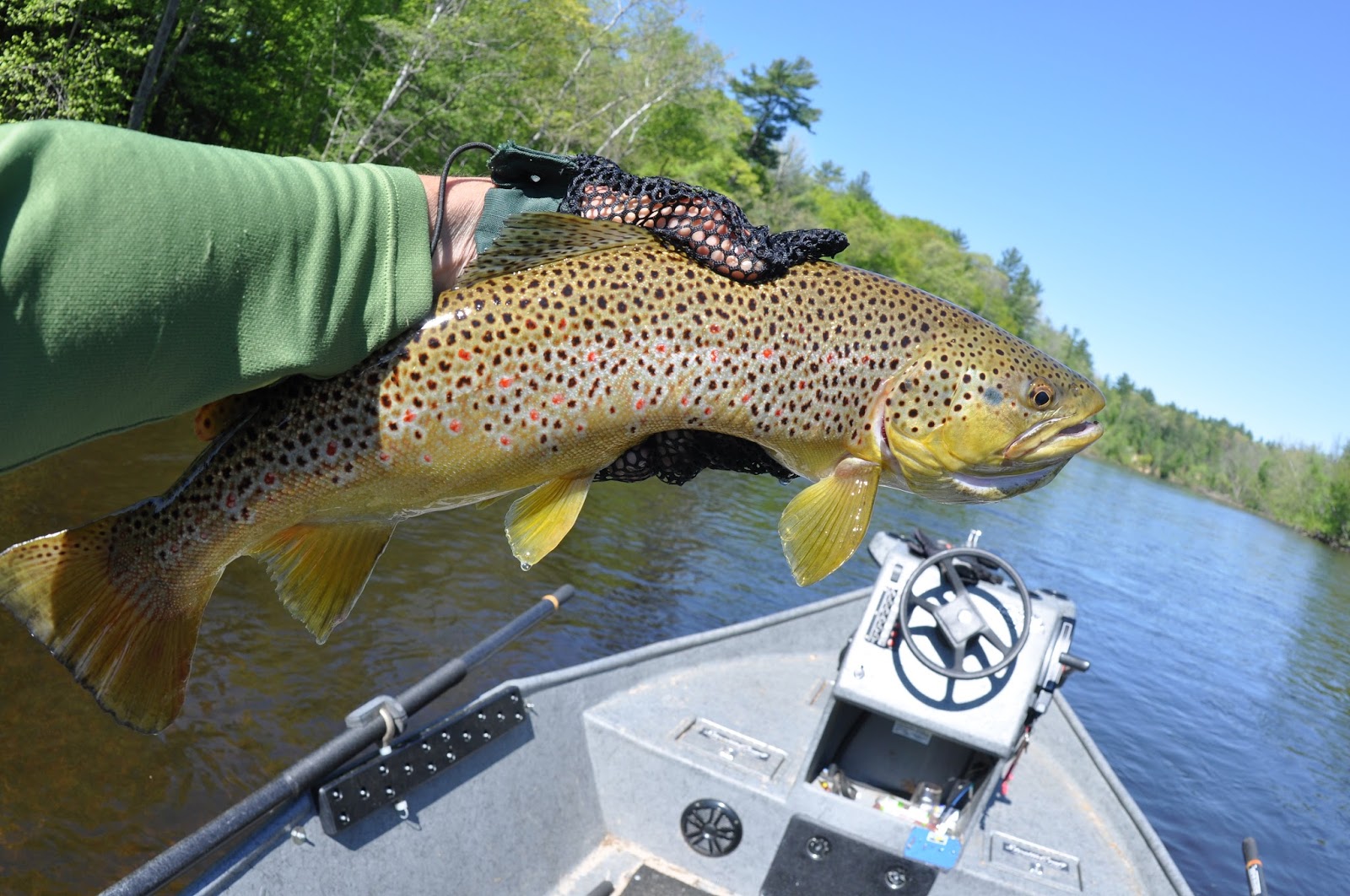
(The Wild Rose WI strain here MI uses in its hatchery programs is a gorgeous brown strain- problem is they take a long time to "get their 'wild' on'- a little too domesticated...Ashallie with May 2015 Muskegon trutta perfection caught poaching on sucker eggs -golden caviar bar none- CBetts image)
( A beasty Muskegon Wild Rose brown -JBacon image)
( check out video of wild Sturgeon strain brown trout stocking in Muskegon November 25th/2015 courtesy of Matt Z Zudweg- Facebook)
The Muskegon tailwater is an extremely fertile ecosystem that has produced trophy brown trout for decades, despite not being managed for such due to much attention on the steelhead, salmon, walleye and rainbow trout fisheries.
The brown trout- salmo trutta, is the ideal "fit" for this very fertile tailwater river and other woody debris and spring fed MI cold rivers to produce a world class big brown trout fishery that could eventually rival the White, Delaware etc. if managed properly. The Au Sable/P.M/Upper Manistee already has those fisheries but they lack protective slot regulations to protect 'breeder" stock for their wild fisheries, which other serious brown trout states have in place.
With this initial planting of wild Sturgeon strain-11/25/15, finally and hopefully our point is being drilled home to our managers after years of pleading with them that we need better wild strains that will establish the fishery- everything (ecologically) in the river is perfectly aligned for a massive trutta takeover! Time will tell how these larger fingerlings do- I'm very optimistic!- here are my 10 reasons why.
1.MARGINAL = TROPHY BROWN TROUT IDEAL WATERS
I hope I dont lose you here- bare with and indulge me for a bit. The Muskegon has always had a tinge of "marginal " label due to one impoundment- Croton, heating up in two summer months-July and August, pushing water temps up to 70 on very hot summers. Luckily, the new 'global climate change' trend for the midwest and northeast for the past three years have been very, very cool summers- the trout loved it.
However, even when water temps approach the low 70's , trout on the Muskegon can be seen feeding heavily all day on the massive caddis and midge hatches- totally unaffected by the water temps.
From a biological (PFP)- 'predator foraging profile', the vast benefit from the caloric mass intake outweighs any physiological stress exerted- thus the balance falls in favor of feeding rather than dormancy and energy conservation. On most 'freestone' rivers, they get heated up , trout shut down and 'slink out' like snakes-not so on the Muskegon. The trout look like little footballs all summer due to their caddis/diptera diets and are quite happy despite less than "ideal-blue ribbon-45-58F TEMPS. Keep in mind almost all the "blue ribbon Michigan trout waters " run up water tempos in July/August- the Au Sable/Pere Marquette ...on and on.
The key is 'thermal refuge areas', where ice cold subterranean aquifers provide safe haven for stress periods. Out of all the Michigan rivers, the Muskegon is "LOADED WITH SPRING SEEPS/POOLS", due to the higher river gradients of the Muskegon that cut through rocky morainal spring bedrock caverns( high rollaway good example). Actually water temps can be " the worst' at the Croton Dam from thermal warming. Note that Hardy Dam/Reservoir has a very deep water ice cold draw that mixes it up. Plus the new oxygen/cool water bubbler at Croton has made a big water quality difference in favor of all summer long trout feeding and growth- up to one and a half inches through the summer. From Thornapple to Henning there are 286 documented spring creek/seeps entering the river. This section actually remains the coolest all summer from the springs
( A beasty brownie I caught from the lower river June
/15/15 )
It's also interesting to note that most of all the truly trophy browns are caught from Thornapple to Old Womens bend- 6 to 18 miles away from the tailwater release...seriously?- why is that?
Let's look at other tailwaters/rivers in the world and why big browns tend to favor and "LIKE" marginal waters. Often these waters are highly energized in the warmer food chain and contain a larger biodiversity of food/prey, much to a big ravenous brown's liking. They also carry more' good pollution', which actually energizes the food chain- sounds crazy! Also browns tolerate and prefer higher water temps, more bio/polluted waters than both brook and rainbow trout. Also being 'marginal' water, it has less trout per mile densities and more coarse fish density- chubs/shiners/dace , and less competition for a slow moving, cautious beasty big brownie to gorge more easily and with less competition and restaurant.No matter where you find them, suckers and carp , you will usually find big browns. I recall my days fishing Spruce Creek- a magnificant spring creek in PA- find the suckers?...you'll find the big browns!!

(the 'Big Manistee'- another 'marginal Michigan tailwater' water that is stocked extremely heavily with browns and grows monster leviathans despite the water temps from Tippy and Hodenpyl dams)
Look at the the lower Au Sable/ lower Pere Marquette, they have "marginal water temps' in summer, but that is where most of the "leviathan"/donkey browns live. Look at the lower Letort in PA- leviathan trout water. Lower Battenkill VT/Farmington CT/Big Delaware NY/PA...all big trophy brown waters!!!-despite warmer temps!
A real eye opener came to me and the NY DEC biologists on our summer cabin tailwater river in the Catskills, the Neversink
( Mandy 'Nanda' Sanasie- 'the Euro Nymph goddess' with a gorgeous Farmington tailwater CT brown this past summer- many of the big hogs come from the lower river stretches here)

(for more reading and info: the amazing Neversink tailwater- ground zero of American Fly Fishing- Gordon/Hewitt/LaBranche waters- a complex conundrum ecosystem- see my Fly Fisherman Magazine article on it- September 2008-'' Selectivity', talks at great length about this....also my article in Fly Fisherman-Oct/Dec 2010- 'Brown Town' has some interesting insight )
Where we have our summer family home in the magnificent Catskills of NY, The Neversink tailwater runs out of the brutally ice cold and deep( 175 feet) Neversink Reservoir- that drains the ice cold Slide Mountain section of the upper Neversink branches. I once stood in the upper tailwaters over July 4th weekend when the air temps were 99/100F, and the water temps were in the upper 40'sF and froze to death in my breathable waders- had to wait to 1..2 o'clock to see the first sulphur hatches because of the cold waters.
Here is an example of where the biologist, Bob Angyle was perplexed year after year when they electro-shocked the "perfect blue ribbon quality' upper waters and only found juvenile wild browns in the 3-8 inch range- plenty of them, but hardly no big brood stock browns. The upper waters had migrating browns for the late fall spawn but they soon left because it was" too blue ribbon cold". Where he and his crew more progressively kept finding the big wild browns was where the waters turned/approached ' marginal'....59F to 68/70F- with a mean preference for waters in the low / mid/upper 60'sF....and well into the scenic gorge special regs area which gets really heated up with the hot east coast summers.... INTERESTING EH? So there you have it...marginal=big brown waters !....
2. BROWN STRAINS AND AVIAN/ANGLER PREDATION/SURVIVAL TO TROPHY SIZES
Michigan, since being the first "ground zero" brown trout stocking in the western hemisphere from Germany, with its thousands of miles of 'blue ribbon' trout waters, has produced more distinctive wild strains in its 130 year history with these magnificent European immigrants- (glad Trump didn't shut the border down for 'trutta' invaders- and hell they were German!)
.Originally scorned as impossible to catch and took away from the beloved brook trout their domain, they eventually became worshiped for their top water 'dry fly' preoccupation and their crocodile aggressive/active tendency to predate like savage beasts on streamers.
Michigan has produced for stocking two strains in particular that are absolutely gorgeous and wild as can be- The Gilchrist creek and Sturgeon river strains.

( A gorgeous Gilchrist brown taken on a sulphur hatch on the lower Muskegon when they stocked them in the early 2000's- note the butterscotch color and the gorgeous red spottings so perfect of a German strain brown from ground zero.Last spring and the prior June, according to Gary Whelan/former cheif hatcheries director, 25,000 of the brown plants in 2015- and 4,000 in 2014 ( those are on the stocking charts), were Gilchrist on the Muskegon planted at various locations due to the relentliss insistence of a 'pain -in -the ass' Polish/American guide and author on the Muskegon- ;)- but if you look in the stocking tables it still says "Wild Rose strain", which I belive is a mistake or unwillingness to admit defeat..LOL!)...also the "wild rose "strain are inbred hatchery trout and as far from wild as possible- but they are gorgeous trutas once they feed on natural food and do well I must admit !

( here is a gorgeous" wild rose" strain from the Muskegon- they have very complex marble spotting and red dots once they pursue crayfish/insect/scud diets. They are a great strain from Wild Rose , Wisconsin, but they are easy to catch, suffer high mortality in the spring for their unwillingness to spread out fast and get away from people at the landings tearing worm hooks out of 6.6 inch trout that have to be legal at 10 or 15 inches- their hatchery inbreeding has made them less cautious,they school endlessly in search of pellets and take them longer to get 'wild")
Now for the newly cultured and wild Michigan Gilchrist and Sturgeon River strain, thess can be the "golden chariots' when combined with the wild rose. These are a hearty wild strain that can be both migratory to the big lake and come back as trophy lake/sea run browns, or can establish residency in larger river systems like the Muskegon due to their enormous food supply- ( note: some of our steelhead dont smolt until 14-15 inches since the Muskegon food supply borders on overload!- and they forgo 'silver smolting' for a year and take on river rainbow spotting- we saw this when they had right pectoral fin clipped the fish and we thought we caught beautiful eagle lake looking bows with right fin clips in the winter at 14 inches- they should have been gone!- from a biological standpoint. Remember, fish don't always do what the bio data and models tell us "they should do"- with global climate change "the models" will become more unorthodox and whacky IMHO!)
STOCKING/PREDATION
(Nov 25th stocking of Sturgeon strain on Muskegon- MGuzniczek images)
It is also important and interesting to note that when they stocked the 'wild strain' 50,000 Sturgeon browns , they dispersed from the boat ramp stocking locations almost immediately. The domesticated wild rose and other strains lay around the landings for weeks and are subject to mortality from boats, bait monkeys ripping crawler harnesses out of their mouths and of course those beautiful avian blue herons/ospreys/king fishers that gorge on them- the birds can almost hear the hatchery trucks engines coming from miles away!!!. The same goes for the Gilchrist wild strain- they disappear and usually dont show up for 6-10 months until their aggressive feeding drive takes over at 9-14 inches- (
NOTE: YEARLING BROWNS STOCKED AVERAGE 5-6 INCHES in Michigan- most must grow to 10/15 inches to be legal harvest).
Last years avian predation of trout on the Muskegon really destroyed the fishery-9-14 inch trout were demolished by cormorants/mergansers diving ducks since the Great Lakes froze over and the birds flew inland until they found open waters for baitfish prey and easy pickings trout. Also the water shut off by Consumers Power on two separate occasion because of their computers 'icing up-LOL" on 37 below zero nights did not help. The browns from 16-26 inches survived and had more food- thus we saw more trophies than normal- but not many!.
The extreme wariness of these wild strains is excellent for long term trophy survival. I often talk to hatchery personnel and they say the Gilchrist and Sturgeon strains are very tough to raise. They must be kept covered and in the dark often, they wont eat if startled and all their "wild" behavioral attributes are always in place.
FINGERLINGS VS. SMOLT/YEARLINGS
Here is a big one!- and I'm sure Ill get many 'heated up, 'what the hell is this man saying!!(me) debates over this from 'by the book/old school ' biologists- have at it!
Most!!...not all studies suggest greater survival of stocked trout with larger fish- makes sense, but does it always????...not so sure and we have plenty" recent" evidence it does not always pan out like we expected .
One problem is larger smolts /yearlings hang around in schools by landings and stocking points like confused children looking for Mama's pellets!!!!... They are heron prey par excellence! Having been feed hatchery pellets longer takes them longer to get weaned off the pellet crack.
Wild fingerlings on the other hand adapt to wild food forms quicker, disperse immediately and go their separate wild ways looking for cover and a food niche-it takes weeks /months for the other yearlings. It is for a 'put-and take" fishery, what our beloved biologist, RO , likes to manage for, the larger stocked fish can be killed quicker and dumber. That is not trophy mentality for the bigger brown trout which the Muskegon produces despite the lack of" big trout management goals"-which the trout keep telling us by their size they want to be eh???.
I believe the fingerlings disperse and blend in with all the other baitfish, thus are not highly and specifically targeted, thus cloaked for larger survival and can hide along the skinny shorelines where bigger predators- walleye/bass /big trout won't lurk.
When we caught the IGFA world record Atlantic at Torch, the DNR already stopped stocking smolts three years prior since the smolts were yielding poor returns and were expensive to raise. Due to public outcry and the press/me insisting the program continue, they stocked fingerlings that fall and have been doing so for 4 years. It wasn't their ideal choice since all the smolts were being dumped in Lake Huron tributaries:AuSable etc. to make an atlantic fishery there.
BUT!!!!!!...it turned out by default and accident to be the best thing ever for the Torch Atlantic fishery- even the biologists are perplexed why the fall fingerlings have created an epic atlantic fishery in the past years that yearling /smolts could not do. All the reasons above are the answer... and then some!.
3. ECOSYSTEM- THE MIDGE FACTORY
Lake Myvatn in Iceland is an amazing place...breathtaking when you first see it.
It is a massive volcanic , spring fed oasis of waterfowl, wildflowers and beauty at the headwaters of one of the most famous atlantic salmon and brown trout rivers in the world- The Big Laxa. Here the massive food of Diptera midges:chironomidae/similium creates clouds of midges in the air that can literally choke you on some days. The ducks gorge on globs of midges - so do all the brown trout and atlantic salmon parr. Midges are the ideal food for small fingerling parr of the trout, salmon and steelhead domain.
The Muskegon has now become a "ginormous midge factory", that most tailwaters eventually develope, but I have never seen the vast amount and thickness of midges like it anywhere else .
Biggie!...Why do you think there are so, so many suckers in the Muskegon???- their diets are almost 90% midge larvae as they turn their snouts sucking the juicy rocks full of them.
From May thru November, the midge swarms at dusk are so thick at dark you have to put a muff over your face when you drive your jet. Up until yesterday , yes now in November, the smaller browns from last spring's plantings gorge on midge adults/pupae everyday/all day! That is an excellent thing to have for trout ,salmon, steelhead parr dont always have in other rivers- that's why fingerlings will do very,very well!!!
(these shots were taken a week ago. The spring plant browns/Gilchrist and Wild Rose are totally immersed in a diet of midge adults/pupae and will be all winter- you can see them rise to the black midges in December/Jan/Feb regardless of below zero conditions- get your 6x-size #20's out and have fun- my current article in Fly Fisherman -Oct-Dec 2015 has my WMD midge patterns- tailwaters are giant spring creeks btw in similar habitat /structure/predator foraging profiles )
4.MIGRATORY SALMON AND STEELHEAD
There is a mixed blessing and curse with this equation.Resident trout populations have massive growth spurts from all the steelhead and salmon eggs and millions of wild fingerlings the rivers produce. But also they encroach on spawning opportunities for fall and spring for the trout, so in some instances trout programs must be maintained by stocking do to the hierarchy of large spawning salmonid bullying out resident trout. But overall, and just look at how big our browns get on the Pere Marquette/Muskegon, they and the smaller trout benefit highly from these massive protein onslaughts from eggs and sac fry/parr- incredible growth spurts!!! - and so beneficial to
especially smaller trout/fingerlings.
( trout love the eats!!!!)
5. THE SUCKER SPAWN HATCH
The tiny golden caviar of the suckers spawning brings out all the massive big brown brutes, but the tiny fingerling/parr really benefit from this yet another massive infusion of protein right after and during steelhead spawning. This big trout magic time goes on for a month and the trout gorge- no brainer to figure this benefit out!
6. HATCHES/HATCHES ...AND MORE HATCHES !
(gray drakes fill the nights in swarms for almost a month and a half!)
( J Murphy with a trophy brown- early spring black stonefly hatch-2014)
The Muskegon is blessed with an incredible abundance of all the mayfly hatches, massive caddis and midge hatches from the plankton infused reservoirs and epic early black stonefly hatches. Trout are feeding on tiny BWO'S and midges as I write this in late November. To a trout like the brown that always has its head up and on the surface like its cousin the Atlantic, this river is paradise!!!!
7.CRAYFISH/SCUDS- ANOTHER MASSIVE INFUSION
One of the main reasons large trout are so tough to catch after the gray drake hatch is their attention turns to molting crayfish and scuds, which are found in massive abundance throughout the tailwater- pure protein on steroids!!!!!
8.CURRENT REGS-SEPTEMBER 30TH CLOSING
As much as we need more 15 inch and slot limits to create a trophy fishery , this is good to protect the trout for almost 7 months!
9. WINTER FEEDING
Since the Muskegon is such a fertile tailwater with food on overload, unlike other free stoners were trout slow down their feeding in winter, the opposite occurs here with massive feeding by small trout on midges, scuds and caddis larvae
10. A NEW ERA OF COOPERATION AND MANAGEMENT
With the new Muskegon River Fishing and Sporting Alliance, a new willingness to work to make the Muskegon river a world class trout fishery, the future is very, very awesome and bright!!!!- visit their facebook page and join up.
Hope this sheds light on how our river has all the potential to create in the future, and has already demonstrated how it can be an epic world class brown trout fishery givin some love and respect.
...feel free to email
msupin2583@aol.com
or visit our website and facebook /linkedin /twitter pages!!!!- cheers!/na zdrowie!
Long live the magnificent brown trout legacy of our 'ground zero' Michigan trutta fisheries
( a February brown that crushed a sculpin/hex..and a September scud eater-both from the Mighty Mo!)


 11:22 AM
 Matthew Supinski's Gray Drake/Selectivity/Nexus Blog


 Posted in: