Epicurean Angler-Matthew Supinski's Selectivity/Nexus Blog- Everything Trout/Steelhead/Salmon

Epicurean Angler-Matthew Supinski's Selectivity/Nexus Blog- Everything Trout/Steelhead/Salmon
Showing posts with label dry fly. Show all posts

Friday, June 12, 2020

Next Phase- Iso Time!- the meaty howdy's


 Isonychia bicolor have just started as the drakes continue- (Bug Doctor J.G Miller image). John will be featured in my "Entomo-Logique" department/column in my new online journal coming in two weeks- stay tuned!)

The heavy rains and storms have raise the rivers but lowered water temps. Perfect hatching conditions of the big meaty Isonychias. These are very fast swimming nymphs that hatch from the water on the Muskegon. They really catch the trout's eyes and they and the swallows go mad for them!
They emerge sporadically all day into the evening..The larger trout will target both the swimming/emerging nymphs and hammer the adults.
( my Iso-crack wiggle nymph swung down-and- across on heavy tippets will bring vicious strikes!)

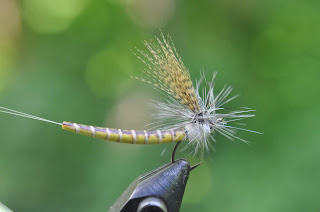
(Here are two CDC adults in the traditional and FrostyFly version)
Here is another look at that magnificent beast of a brown I caught a week ago on the early gray drake spinner fall..one of my finest ever! (that was my 45." salmon/steelhead net


Cheers!
MS

Saturday, May 23, 2020

Realism and Traditionalism- Packed into one powerful delivery- FrostyFly materials

( Nexus book fly plate for FrostyFly/Hemingway- they are sick/and very fish-able and made of materials connected, not "molded facsimiles" like some fly water does not allow)
(Yesterday's care package from Boris- just in time for drakes!- get some!)

In my Nexus book I introduced FrostyFly/Hemingway materials in the fly plates. The stuff is really amazing when combined with traditional materials. They are made from foam/light soft plastic and are light and don't "twist tippets" like the  the other experimental "hard/stiff" materials introduced into the past. They are extremely light and sleek and can be tied with tradition materials..

Boris at FrostyFly/Canadian/Slavic company has done amazing stuff with their materials that are truly "deadly"...check them out and tell them I sent you!

https://frostyfly.com/

I can't wait to try the new caddis wings, could be a shell on top of a clump of CDC feathers tent wing style , They are killers for Hex and all the drakes and sulpher bodies are sick real!

My Gray Drake imitation-lethal! ( body can be tied bent like real spinner)
( Nice brown that fell to the Frosty drake last year- first drift over it!)
BTW- a  very few drakes have hatched but the flood and high waters, plus the very cold reservoir waters are holding them back-THANK GOD FOR SMALL FAVORS!- we cant be hit with any more disasters eh?- think I see a Pale Horse riding around!
                                                                   ( Hex- Brown Drake)


Tuesday, April 14, 2020

Interval Timing for Surface Feeding Big Brown Trout during a Hatch-A Right of Spring

                                           ( My personal best  20+ this spring on my CDC dry during the early black stonefly hatch on the Muskegon. This beauty taught me several new observations)

My goal in this blog is to look at how conditions and the general predator foraging profiles (PFP) of bigger year class brown trout will effect the way you present your dry flies. Interval timing of when and how a bigger trout will take your flies and what frequency is the key to presenting your dry flies is the key to success. Granted not all browns behave the same ( I've found each has their own personalities believe it or not!), which is usually formed by imprinting to selective experiences ( i.e. if they've been caught before, what eye side they favor, how aggressive or timid they are intrinsically ) thus many factors contribute to a take or refusal by the dry fly presenter. 

1. GETTING STARTED FOR SURFACE FEEDING- "TO SURFACE FEED OR NOT TO SURFACE FEED- THAT IS THE QUESTION!"
                     ( Browns and Atlantic salmon-"Salmo" are notorious surface feeders- why dry fly addicts love both!. Here a Delaware brown going vertical ( image by J.G. Miller-Delaware guide master) Marinaro, an influential mentor of mine,  wrote in exclusivity on the three main rise forms of trout- simple, complex and compound in his classic "In the Ring of the Rise". I take his descriptions and elaborate into the actual selection to eat the fly in my "4 Systems Go" approach in my Selectivity Book. My Nexus book explores more synchronicity associations to brown trout feeding on top.) 

First, not all browns are surface feeders. Many bigger ( over 14 inches) fish will stay deep and become carnivorous/cannibalistic , especially in large impoundments/lakes /rivers where large bait-fish populations exist. For every brown that feeds on the surface, there is one equal  cohort that will stay below and eat nymphs on the bottom and ascending. The surface just scares the crap out of some fish that are more photo-phobic than others, usually again in the dark environs of deep pools and big water.
This surface feeding behavioral response is usually imprinted at a very young parr stage/freshly hatched fry etc. If you watch a school of brown trout/Atlantic salmon parr in a school, some will be totally surface focused on diptera/midges, while others are in a "eat each other" mode. This You Tube video by a teacher in a NY classroom shows the ones that are cannibalistic, and the ones that are skimming  the surface for aquarium Tetramin fish food ( most likely surface feeders in the making)https://www.youtube.com/watch?v=zItvMMtPGes&t=150s
Water temperature and the duration of metabolic shutdown a trout has been under from winter to spring's transition will dictate how much surface feeding goes on, and with brown trout; everything they do is slow, gradual and cautious.But once in the groove, their predatory skills and feeding is ruthlessly efficient. Thus  a spring hatch usually takes a few days for  them to cozy up to it.

2. THE STIMULUS TO SURFACE FEED-SIZE AND DENSITY
                                            ( image: surface gulping brown-J.G.Miller)

Early spring hatches are "at the warmest and calmest parts of the day"( an age old dry fly/troutbum saying) Truly a gentleman's type of fishing in the finest comfortable hours of  1 -6 pm ( then after your fishing you waltz straight to the pub for brew, Scotch/Gin and dinner in your Wellington boots and britches like on England's Hampshire chalkstreams.
( The beauty of England's Hampshire Chalk streams- estates, perfectly managed landscape and gardens and the pride of the English Tradition: its beloved brown trout-Takata Image)
As the spring days continue to warm up, the hatches will progress later into the evenings ( 6-8 pm) , such as the Hendickson spinner fall usually taking place while the Gentleman and Ladies retired for dinner- then the wise will be advised to wait it out, as the late spring sunset usually warms after a cold cloudy day.
                                              The Magnificent Rite of a Michigan Spring -
"Many Men go fishing all of their lives without knowing its is not fish they are after"  Henry David Thoreau
 Bachforellen trout (German brown) from my local "ground zero" spring creek,  Grouse drumming, mayflies and the fruits of the Michigan forest and the beautiful wild Michigan steelhead spawning. Despite our political dictatorship disaster, Michigan is still a wild and wonderful freshwater masterpiece of nature)
  

 First of the season hatches  such as Red Quills, Grannom caddis, Baetis bwo's, Early Black Stones , Hendrickson's and midges are usually cold water affairs. Although the ideal text book  for the dry fly code (45-55 F water temps) is preferred for optimal metabolic activity, stones and midges hatch in water temps in the upper 30's.  Daily fluctuations in temperature, weather: wind/storms will play heavily on the duration and intensity of the hatches, since they are driven by consecutive water heating days and barometric pressure. In Michigan we can have a 70F spring day, only to be followed by snow the next- same in the Northeast and Driftless Areas. In very cold hatch conditions, emerging nymphs/still-born cripples will be the favored targets since hatching in a snow storm can damper mayflies taking flight. 
                   (Image: Albert Pesendorfer- European photographer of the finest caliber, for  the-Nexus book)
When a hatch has usually been in progress for at least several days, along with falling water flows from run-off/rain,  the surface activity will progress and steadily intensify with the hatch. The rainbows and brookies will usually partake of the surface feast much quicker than the browns, since they are less cautious and more opportunistic. Browns will be fiendishly plotting their attack scouting for and setting up lies in optimal surface taking niches. Fulcrum interception points in calmer slacker waters will be their feeding niches where the surface insects will flow along a foam line dictated by a funnel of wooded debris/ stream current deflections/ split stream channels or back undulating currents that will reverse the flow ( circular back eddies) 
( The perfect early black stone water and fly)
Again, I can't emphasis the point that browns will be looking for the slower current-less waters which are more likely to warm -up quicker than the main flows due to light penetration and clearer viscosity from siltation settling. When the temps are very cold- long slack water flats in medium depth next to shelter ( logs/bridges/deep pools etc.) are the choices. I was showing one of my neighbors where I was targeting the spring hatches the other day and he said, " I would never ever think to look for trout there, that is sucker water!, doesnt  look like trout water!"-herein lies the key.
Keep in mind that unless water temperatures are perfect (45-55 F) the rising intervals will be the most important thing to study. This is a waiting game of the highest caliber- like turkey hunting in a blind.I often take a thermos and a cigar and sit and wait and watch for a half hour or more before the first cast.You can learn so much more by just chilling out and watching nature interact- it is very soothing. We emphasis activity too much- just watch a blue heron stalk fish and that tells the whole story.
If you find a small pod of risers, it will be most likely a half dozen fish ( usually all browns, or all rainbows/brookies- rarely both, but in dense populations of both like on the Au Sable , they will feed side-by-side), since their water preferences are very different. In the feeding pod, the best position will be usually the largest Alpha dominant brown, followed in lesser efficient lies by smaller year-class fish. The smaller year class fish will feed more frequently, and that is one give away of a larger feeding fish. There is less spatial niche separation with smaller fish thus more competition for food .
( This is a dense hatch compared to the more singular/sparse hatch of springtime)

Once you target your leviathan brown ( can be a 12 incher or 20 incher depending on the size of waters you fish and degree of wildness/stocked populations/holdover etc.), be prepared to spend hours /days stalking it, depending on the degree of selectivity the fish has acquired ( being hooked before, wild, tough lie to cast to (branches overhanging,etc., funky currents) - it will be worth it! I have come up with my early spring hatch "leviathan brown dry fly code" for you to follow:
1. Make as few cast to your target as possible- don't flog the water! Big fish are put down even by the slightest bad cast by a pro ( I know!) watch, and watch and observe some more. 
2. The worst time to cast to a fish is right after you saw it rise.It is swallowing and digesting its food in a slow spring fashion and it takes a little longer especially on a slinked-out belly from spawning and winter. 
3. The feeding interval is the most important thing. Make sure the fish has fed at least twice before you cast to it ( I will wait impatient as hell up to three-five rises- trophy hunters must have discipline ! )
4. Early spring feeding intervals can be 15 seconds , a minute, 2-4 minutes....sometimes 10-15 minutes in separation, regardless of intensity of hatch. Its the metabolic thing again of every fish's interior bio-clock.
5. Fish the longest leader possible- I use 18 footers ( simple homemade one is buy a 12 ft leader to 3x, chop 8-10 inches of the tippet section....add 6 feet of 5x) This is due to the extremely long inspection times a brown has in the slower/slack waters. They will most likely do compound /complex rises, where the smaller fish are simple risers ( Marinaro's code)
6. Use down-and-across reach casts and puddle casts with mending upstream for long drifts.
7. Hook setting should be slow and deliberate in a downstream and low fashion- takes in cold water are very deliberate unlike warmer water.
8. Evaluate the situation your trophy is in. Is it close to cover that it will dart under fast as soon as it is hooked? You must act quickly and steer the ship in the first few seconds of battle. The big 22 incher I caught was next to a log jam and I quickly put enough pressure on it ( be careful not to put too much!) to turn it into the main current away from the wood, which it luckily did and ran downstream.
 ( NEXT:FLY PATTERN ANALYSIS) 


Hope this was beneficial. Happy "head hunting"
Matthew Supinski


Tuesday, April 7, 2020

"Size does matter!"...Selectivity/Nexus Blog (Pandemic Vol:II )

(This fat 18 inch "nerve-racking" surface feeding brownie gave me selectivity presentation fits for two consecutive days- CASE SOLVED AND CLOSED:yesterday afternoon 5:37 PM- who's next!) 

In my last birthday Facebook post I told you about the two frustrating hours I had in a place on the Muskegon last Friday called "the House of Pain". It's a "love/hate " relationship place I named and talk about in both my Selectivity and Nexus books. Its a mile long broad/spring creek-like section of flats on the river with lots of vegetation and shallow runs just like a giant Henry's Fork. Here the trout have plenty of mileage to be ultra-selective/reflective like they can be on the flats of the Delaware in the Catskills or Missouri .
Since  the early 90's when I first moved to Michigan, these flats have been a source of much anguish that have resulted in more perfect fly designs and improved  tail water dry fly techniques. ( my late friend Carl Richards spent almost every evening during the super complicated caddis hatches here of July through September stalking, photographing and scrolling notes and sketches on caddis hatches , which resulted into his master work  " Super Caddis Hatches"- Amato Books. During that processs, I once found him asleep in his car one morning totally covered in caddis sketches as I started my guide trip and banged on the window to see if he was still alive!-such was his passion-God bless his soul!) 
 ( The first of two nice brownies yesterday-a 14 incher  that reconfirmed text book presentation templates)
So to say I am one that will relish and love the frustrating refusals and conundrum of trout flipping you the bird!,, as they scoff at your dry fly is an understatement and demented confessional for the underlying reason why I wrote Selectivity!- if it was easy like bass fishing I probably would take up golf and  wouldn't  go to the ends of the earth to chase the last trutta swimming . 
So back to last Friday, the two hours of the hatch was heavy with hundreds of early black stone fly females ova-positing on the surface and swarms of bazillion clusters of black midges . The half dozen or so nice browns I scouted and stalked totally refused ( some of the refusals were slashing surface bursts at the last minute when I lifted to set the hook and nothing was there!)the hundred plus presentation of my CDC stone I threw at them ( all perfect drag free/long drifts and the same pattern that caught the 20 incher there a few days earlier. I also noticed midge clusters being gulped ( occasionally but far less frequently than the desired big stonefly meaty)  between larger stone fly confirmed " eats" while I sat and observed. 
The water I was fishing was at least 5 feet deep, moving fast past a large fallen tree sweeper which created a 15 yard long calm back eddy where the browns would take up their daily afternoon feeding stations- each was fish was spatial niche separated in perfect trutta dominance fashion ( niches are discussed in detail in my Nexus book) I anchored my jet as close as possible, since the faster water swept my fly line quickly from the placid water that the fish fed in. So to say I was kneeling in my jet/drift boat was accurate- no standing casting!, and long 10 minute pauses between casting sessions to give the fish a chance to feed in regular intervals
So!...Deja Vu crept in yesterday reminding me of Friday and quickly set in after a half hour of refusals as I watched stonefly after stone get gulped by the browns...something is really wrong here. I have a 18 foot leader, with 4 feet of 4x, the same deadly CDC stone I had that caught the 20 inch brown there- same set up!-wtf! My casts were perfect puddle casts with upstream mending giving my dry a long drag free float - as I'm pulling my gray hair out in frustration as I watched one adult after another get gulped and mine refused. THAT'S IT!..I'm going to change something. 
One of the biggest obstacles to " thinking outside the box" is being older and confident in what you are throwing and being a little advanced in the old " knows enough to be dangerous" category- knowledge is not always liberating my friends, especially if a 20 inch brown loved the same set up I was throwing. In my stodgy author stubbornness I saw nothing wrong with my flies or presentation until I took a serious look at them, with a pragmatic " Selectivity-step-by-step" unbiased approach. 
First thing was to look at conditions. It was pure blue sky sunshine like the day the big brown took the fly, but the water has dropped considerably with less CFS flow and cleared up substantially -check 1!. There were just as many naturals on the surface so hatch intensity was the same -check 2. Since I was using 4x in the heavier flows, I did the customary thing to do, drop down in size and went to 5x -check 3. And to triple insure that what I was doing had no 'unseen drag", I lengthened tippet from 4 feet to 7 feet-check 4. But checkpoint 5-that!,  was the age old template that never changes- fly size-check 5 was as the ultimate  " THAT'S A BINGO", as Col. Hans Landa ( Christoph Waltz in Inglorious Bastards) proclaimed enthusiastically.
( The one on the right was the new lethal killer, the left was the old one one I clung to, and rightfully so by the brown I caught on it)
Looking at both flies , to the untrained eye they look pretty much the same.  But obviously they weren't to the eye of these extremely selective Muskegon browns that were were refusing the one on the left for hours.In my Selectivity book I talk about the "4 SYSTEMS GO" approach to a selective/reflective view of a dry from below the surface. The laws of refraction enter into the first law, as the trout saw the bulky wings triangular and horizontal, rather than the true look of vertical drumming wings on the right. The left stone was on a true #12 wide-gap dry fly hook, with a very thick clump of dark dun CDC that were stiff and tent-like in from below silhouette ( what the browns were seeing). So I changed to the one on the right ( go smaller fly template of traditional selectivity laws) It was on a Daiichi 1270 curved hook -#16, and used light dun "spiked and sparser" CDC. The thought was that the light dun would transmit the vertical wing fluttering better that a a flat darker splayed v-shaped wing profile like a caddis for instance . Using Lochsa ( Loon) CDC fly floatant to spike the wings up even more, the rest ladies and gentlemen is now a glorious selectivity history and lesson learned. 
3RD CAST! ...a nice fat 14 incher slammed it !...( one of the ones that was giving me the finger for over 3 hours. Landed it!...5 th cast later, the fat 18 incher slammed it and went ballistic in the frozen waters. 
(This!, is the PERFECT TIE)


Day over. I won. Life is good. Victory is sweet. Never give up. "always expand your mind". Ignorance = same as too much knowledge and being stodgy can be your biggest detriments  
CASE CLOSED
Matt Supinski


Wednesday, March 11, 2020

The Gray Drake mayfly hatch is here!...come experience this amazing big brownie dry fly nirvana -Also my favorite recipe!


 25 years ago we named our lodge and outfitters "Gray Drake Lodge" for a reason. The Muskegon River has one of the most dense and long lasting gray drake mayfly hatches on the planet! Only the Pere Marquette and other nearby rivers sourcing   from the same marl bog watershed have these hatches in such density. Baltic countries also have them. When we opened up our cedar lodge during the hatch in early June, the next morning the entire lodge turned gray from all the adult mayflies molting on the cedar panels and tree trunks from the previous night's hatch.

( insect images by bug master JG Miller)
( Morning and early evening spinner flights were gray blizzards last year)
( Freshly hatched gray drakes molt on the lodge and trees nearby. The Muskegon browns that take drakes can be ultra selective and have stunning colors brought on my heavy protein overloads from salmon/steelhead and sucker eggs and scuds in winter )

This spring 2020 (June when we open back up) we will be offering single/double  and small group Gray Drake Clinics. 
Our focus will be on dry fly and swinging emerging wet fly guide trips that incorporate school-like clinics on how to better understand the dynamics of this "mystery hatch", which the famous Dick Pobst once described it in an article in Fly Fisherman in the 90's. Many anglers are confused about the drakes and are usually baffled by their behavior, how the trout take them, what presentations are best and when to strike the hatch right! We will attempt to teach the the selectivity approach to mastering these hatches and a 20 inch brown on the dry fly reality!
These  larger mayflies bring up the big browns that are often elusive all year other than on the streamer. But the intricacies of the hatch and how selective browns feed on them is a cloaked mystery to many anglers.We have been studying these hatch details for two decades and would love to share them with you!
Last year (2019) we saw one of the heaviest gray drake hatches we have seen in over 15 years- it was a solid morning to dusk  spinner flight event that coated the water thick as sawdust with spinners. 2019 had a long cool and moist spring/early summer which favors the gray drake hatch cycle.
(A few fat butters from gray drake season )


The hatch cycle of Siphlonurus has been a mystery since you will never see an adult dun on the water. Thanks to the bug doctor:Johnny Miller of Catskill fame, who worked at the Gray Drake Lodge for many years, he uncovered the mystery. Honing the darkness middle of the night hours and shorelines/ swamps of the Muskegon's banks, he found the nymphs to swim like minnows and crawl up on shore in the middle of the night and hatch and fly off in the brush ( midnight till just before dawn). Johnny, as in the style of Caucci and Richards, photographed them hatching in his aquarium tanks- here are his images 
( nymph here crawling up on wet stick)

Besides the other local hallowed Pere Marquette river that has dense hatches, the Muskegon hatch is a 4 week long magnificent display of nature like no other! The Siphlonurus mayfly ( rapidus, alternatus, Quebencences ) is a true #10 sized mayfly that is perhaps one of the most elegant mayflies and has blizzard flights in both the A.M. and P.M.- most only think of dusk!


FLY PATTERNS
I have taken my gray drake patterns developed over the last two decades to new heights recently in my #browntroutatlanticsalmonnexus and #selectivity book fly patterns. Using new materials I've incorporated realism and imitative search patterns that target predator forager feeding profiles during the hatch period.  The larger selective brown's feeding can take on unique on preferences and key in intricate spinner patterns , sunken spinners and wet swinging articulated swimming  patterns. As the hatch thickens their selectivity rises and can take on "hair pulling" frustration. Our clinic trips will teach the intricacies of these patterns and how to present them.
MY FROSTY HEMINGWAY DRAKE RECIPE  (From my Nexus Book)
The realism and effectiveness of this pattern is truly remarkable! I have been perfecting gray drake patterns for over 25 years and this is beyond the best!
Thread: Light Grey
Hook: Daiichi Short Shank Dry wide-gape 1110
Tail/Body: Frosty Flies Realistic extended body Mayfly foam-Gray Drake -size Medium
Thorax: Hareline Ice Dub UV Peacock
Wings: Organza Dun with Light Dun Hackle


(Here is Rich Felber's magnificent 28 inch beast of a brown taken 2019 on my Gang Bang double. Rich has been an awesome gray drake chaser for years
and is one of the fishy-ist dudes I know!- that was the biggest brown taken on the gray drake spinner fall last year!)

(Drake magic time)

A BROWN TROUT FISHERY HAS BEEN UNLEASHED
( Going a full year now with the TYPE III regs and safe to say, is working very well and the larger browns are now becoming a strong year-class)
With the new trophy 15 inch brown regulations now in place for two years and the amount of 13-17 inch browns and 20" er's we have taken on nymphs and streamers this past winter and during the early black stonefly hatch on dries, the trophy brown fishery is ready to explode on the Muskegon! 
My Final Thoughts 
This 2020 spring, as we struggle to get back and re-open our services and everyone's lives to some semblance of normal with all the Covid pain and anxiety everyone has suffered, there is hopefully exciting things to come! For those that have been blessed with survival and my condolences to those that have lost loved ones ( I lost a cousin I played with in Poland as a boy, a strong, healthy, rugby playing Doctor to this terrible thing last week I am sad to say) I pray good things will be brewing despite our hardships.It has taught me, and hopefully all of us to appreciate the things in life we have taken for granted: family, loved ones and the simple things like having another day on this amazing planet to see and witness the wild natural beauty that has been created for us. It has been a very cold spring which is ideal for the gray drake hatches to endure for great lengths of time.and intensity. Last year's hatch was the strongest we have ever witnessed in my 25 years on the Muskegon. It became a day-long event from morning until dusk, which I have never seen and lasted a good solid 4 weeks. The gray drake hatch will be the telltale sign of great things to come when every brown in the river will be poking their heads up to eat drakes on the surface.
Please still stay safe, strong and positive!...this thing is not over yet and lets not be foolish and careless in our actions!
Cheers!,
Matthew Supinski
 Call or email us for more info!
COME JOIN US!

231-250-2846